Pregnant and Baby More Active When Lying on Back
Does Lying on Your Back During Pregnancy Increment Stillbirth Take a chance?
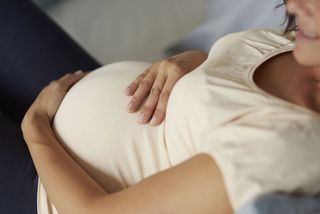
For women in the 3rd trimester of their pregnancy, lying downward on their back may place stress on the fetus, which could increase the take chances of stillbirth in certain cases, a small new study from New Zealand suggests.
However, experts say that information technology's also early to brand recommendations based on the findings, and that significant women do not need to change the mode they lie down as a result of the report.
"Information technology is not possible to draw a firm link between maternal position and stillbirth take chances from this report and further robust research is needed," Hannah Knight, a spokesperson for the Royal College of Obstetricians and Gynaecologists in the United kingdom of great britain and northern ireland, said in a statement. "Women should slumber in a position that is comfortable for them," Knight said.
In the study, the researchers at the University of Auckland monitored 29 healthy, pregnant women and their fetuses while the women lay down in unlike positions — on their right or left side, and on their back — for 30 minutes at a fourth dimension. The women were 35 to 38 weeks pregnant. [9 Uncommon Conditions That Pregnancy May Bring]
The researchers found that, when the women lay on their backs or their correct side, the fetuses were more likely to be in a sleep-similar state that's associated with using less oxygen, compared to when the women lay on their left side.
In addition, when the women lay on their back, the fetuses were more likely to switch from being in a more active state to the slumber-like land, compared to when the women lay on their left side.
The researchers also looked at the fetuses' center charge per unit variability, which is a measure of the variations in the interval betwixt heartbeats. They found a link between those significant women in the study who lay on their back and a reduction in heart rate variability in the fetus, compared to those women in the written report who lay downwards on their left side. Lower middle rate variability is known to precede fetal distress, the researchers said.
Overall, the researchers said that their findings propose that, for the women studied, lying on the dorsum is mildly stressful for the baby, and the fetus adapts to this by switching to a state where less oxygen is consumed.
They speculated that in sure cases, such as when the fetus is already deprived of acceptable oxygen due to other factors, the fetus might not be able to adapt to the extra stress that's imposed past the mother lying on her back. However, none of the women in the study had a stillbirth.
"The supine position may be disadvantageous for fetal wellbeing and in compromised pregnancies, may be a sufficient stressor to contribute to fetal demise," the researchers wrote in the Nov. 22 issue of the The Journal of Physiology.
All of the women gave birth at full term, and neither the newborns nor their mothers experienced whatever complications.
"Information technology is important that women are not unnecessarily alarmed by the results of this small study of 29 women, none of whom had a stillbirth," Knight said. She likewise noted that the study measured the occurrence of a slumber-like state in the fetuses, "which has little evidence of whatever association with hypoxia, brain harm or stillbirth."
This study is not the starting time to suggest that there'southward a link between the mother's position while she is lying down and a adventure of stillbirth. In a 2011 studyof about 500 women, the aforementioned grouping of researchers found that women who slept on their back had an increased chance of stillbirth compared to those who slept on their left side. In that study, the researchers calculated that the risk of stillbirth for women who slept on their back or their right side was about iv out of 1,000, compared to almost 2 out of 1,000 in women who slept on their left side.
The researchers noted that in their new report, they looked at the effect of maternal positions only while the women were awake, and only for a very short period of time, said study researcher Dr. Peter Rock, a professor of maternal fetal medicine at the University of Auckland. More enquiry is needed to examine the physiological effect of staying in certain sleeping positions overnight, Stone said.
Original commodity on Live Scientific discipline .

Rachael has been with Live Scientific discipline since 2010. She has a master's degree in journalism from New York Academy's Science, Wellness and Ecology Reporting Programme. She too holds a B.Southward. in molecular biological science and an M.S. in biological science from the University of California, San Diego. Her work has appeared in Scienceline, The Washington Post and Scientific American.
Source: https://www.livescience.com/56959-pregnancy-lying-back-stillbirth.html#:~:text=In%20addition%2C%20when%20the%20women,lay%20on%20their%20left%20side.
0 Response to "Pregnant and Baby More Active When Lying on Back"
Post a Comment